


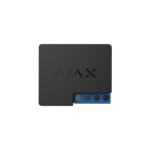
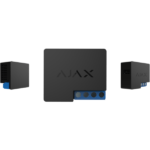


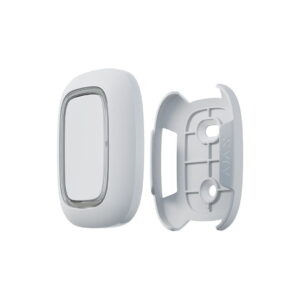
Ajax Relay: wireless potential-free relay
The Ajax Relay is a wireless, potential-free (dry) relay contact. The contact is separate from the power supply of the relay, so you wire it freely into your own circuit and switch exactly what you want: from a low-voltage control input to mains voltage of 230 V, up to the contact limit.
This is how you control a gate, an electric lock, roller shutters or a garage door, or switch a lamp, pump or other 230 V appliance on and off separately. The contact can be set as normally open (NO) or normally closed (NC) and works in pulse or bistable mode. You control it via the Ajax app or an automation scenario.
What the Relay does
Potential-free (dry) contact
A galvanically isolated switching contact that you wire freely. Switches resistive loads up to 13 A at 110-230 V AC (5 A at 24 V DC) and inductive loads up to 8 A at 230 V. The relay does not supply power to the load itself.
NO/NC, pulse or bistable
Choose normally open or normally closed, and a short pulse (for example to open a gate) or a fixed on/off position. Control via the app or a scenario.
Wireless via Jeweller
Connection via the Jeweller protocol (868 MHz) with your Ajax hub. Low standby consumption (less than 1 W).
Compact to install
Compact size (38 x 25 x 18 mm) that fits in a junction box. Mount it neatly on a DIN rail with the Ajax DIN Holder.
Relay, WallSwitch or Socket?
Three ways to switch power with Ajax. If you want to simply switch a 230 V appliance on and off with consumption insight, the WallSwitch is usually the most convenient choice. If you need a free, potential-free contact (also for DC or separate circuits), choose the Relay.
| Model | Type | Switching 230 V | Measure consumption | Power supply | Mounting | Ideal for |
|---|---|---|---|---|---|---|
| Relay | Potential-free dry contact | Yes, up to 13 A (resistive) | No | Own 7-24 V DC (separate) | Free wiring | Gate, lock, roller shutter, free circuit |
| WallSwitch | Inline power relay | Yes, inline up to 3 kW | Yes, in the app | From the 230 V line | Inline in the line | Switching and measuring a fixed appliance |
| Socket | Smart plug | Yes, plug-in appliances up to 3 kW | Yes, LED indication | From the wall socket | Plug in, no installation | Individual appliance via the plug |
Technical specifications
| Relay contact | |
| Type | Wireless potential-free (dry) relay contact |
| Contact position | Normally open (NO) or normally closed (NC) |
| Switching modes | Pulse or bistable |
| Max. load (resistive) | 13 A at 110-230 V AC; 5 A at 24 V DC |
| Max. load (inductive/capacitive) | 8 A at 230 V AC; 3 A at 24 V DC |
| Consumption meter | No |
| Power supply and communication | |
| Separate power supply | 7-24 V DC (separate; does not supply power to the load itself) |
| Communication | Jeweller (868.0-868.6 MHz) |
| Standby consumption | Less than 1 W |
| General | |
| Dimensions | 38 x 25 x 18 mm |
| Hub | Requires an Ajax hub |
Frequently asked questions
Can the Relay switch 230 V?
Yes. It is a potential-free (dry) contact, so you can route a circuit through it freely, including 230 V mains voltage. It switches resistive loads up to 13 A (at 110-230 V AC) and inductive loads up to 8 A. This lets you switch a lamp, pump or appliance on and off, or operate a low-voltage control input of, for example, a gate or garage door.
What does potential-free mean?
The switching contact is galvanically isolated from the power supply of the relay. You wire the two contact pins freely into your own circuit; the relay only makes or breaks the connection and does not supply any current to the load itself.
What is the difference from the WallSwitch?
The WallSwitch sits inline in the 230 V line, switches up to 3 kW and measures consumption in the app. The Relay is a potential-free contact that you wire freely (also for DC or separate circuits) and that needs its own 7-24 V DC power supply, without consumption metering. If you want to switch a 230 V appliance simply, with insight into consumption, choose the WallSwitch; if you want a free, potential-free switching contact, choose the Relay.
Do I need a separate power supply?
Yes, the Relay runs on 7-24 V DC and that power supply is not included. For a neat installation in the meter cupboard, the DIN Holder is useful.







Dennis Peters (verified owner) –
Ideal for switching remotely or per scenario, to add different systems to the hub.