Why motion detectors react to animals and how to avoid this
After you have installed motion detectors at home, you expect the system to respond immediately to intruders. If a thief steps over the threshold or smashes a window, an alarm is triggered. And you can be sure that any high-quality alarm system can handle this task. But responding to motion is only half the job: an important quality of a detector is the ability to determine what exactly is moving. It must detect a person quickly and accurately, but at the same time it must also ignore weather elements and pets, so that you and the security company can be sure: if the security system raises an alarm, there is a real threat and you must respond immediately.
This article explains how infrared motion detectors see the world, which technologies they use to tell a shepherd dog from a villain, and what pet owners need to remember when installing an alarm system at home.
How infrared motion detectors work
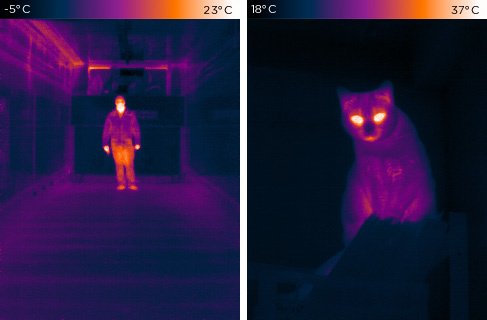
Motion detectors based on infrared sensors pick up infrared radiation or, in other words, heat.
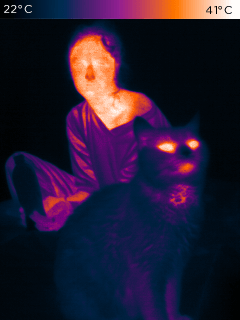
The closer to white, the stronger the radiation and the warmer the object.
It is sometimes said: 'The motion detector saw a man.' But in fact these devices do not see objects, animals or people. In practice, it is only about data.
A specially curved Fresnel lens focuses the infrared radiation onto the pyrosensor of the detector. The sensor signals are then sent to the microprocessor, which converts them into digital data. This is followed by a threat analysis and assessment, and that is precisely the main difference between smart detectors and their primitive counterparts. Using knowledge of the intensity of the infrared radiation and the dynamics of the object's movement, software algorithms determine the nature of the threat, and the detector decides whether to raise an alarm or ignore it.
The implementation of pet immunity in the Ajax motion detectors
Indoor
When the MotionProtect, MotionProtect Plus, CombiProtect and MotionCam motion detectors are correctly installed and configured, they ignore animals up to 50 cm in height and weighing up to 20 kg. The maximum weight is defined as an understandable point of reference, but in reality the size of the heat spot in the infrared spectrum is what matters. Keep in mind that detectors do not see objects, but instead analyse the infrared radiation of these objects.
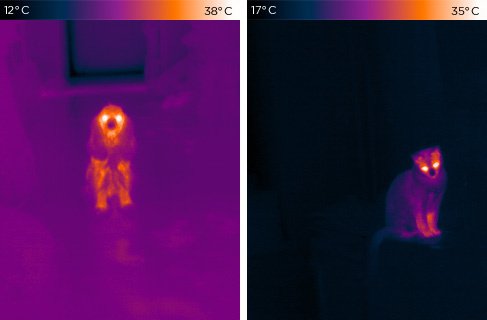
Motion detectors become less sensitive near the ground. That is where large pets are normally found.
Our motion detectors use the software algorithm SmartDetect, developed by Ajax Systems to assess the threat. When motion is detected, SmartDetect analyses the signal waveform of the infrared sensor and compares it with values specific to human movement. Because the heat spot of an animal is small and the signals arrive in the lower zone of the Fresnel lens (which transmits less radiation to the sensor), the detector does not raise an alarm.
Ajax motion detectors also use a system that compensates for temperature. It increases the sensitivity of the PIR sensor when the ambient temperature is close to human body temperature (36 °C) and lowers the sensitivity when the temperature contrast between the body and the surroundings is high. Such a system ensures that the detectors keep working efficiently across the entire temperature range and protects them against false alarms at low temperatures.
Outdoor
The MotionProtect Outdoor detectors do not respond to animals up to 80 cm in height. To ignore typical outdoor interference, these detectors are equipped with two infrared sensors and read signals from two areas in the space. They only trigger an alarm if both sensors detect motion.
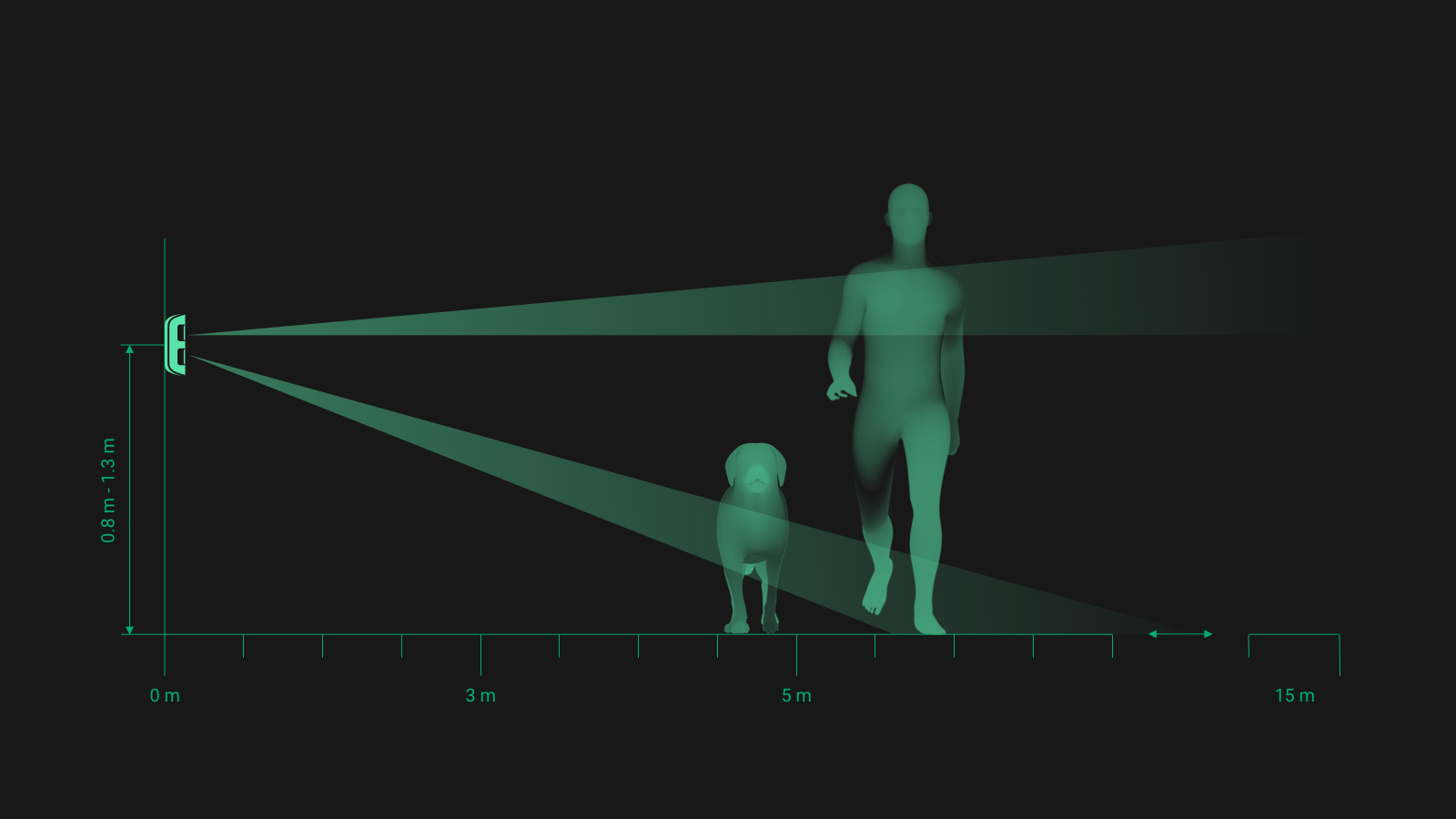
Like the Ajax indoor detectors, MotionProtect Outdoor uses the SmartDetect algorithm, the first software-based level of protection that prevents a false alarm. The algorithm analyses and compares the data from each sensor. At this stage, the detector is by default ready to decide whether to ignore or trigger an alarm. But if the situation is unclear, the spectrum analysis covers the frequency components of the signals from two sensors. This false-alarm-free protection system, unique to security detectors, was given the name LISA.
Take the following into account so that the motion detectors can ignore animals
1. Make sure the motion detector is installed at the optimal height.
The MotionProtect, MotionProtect Plus, CombiProtect and MotionCam indoor detectors are installed at a height of 2.4 m. When used in rooms with pets, motion detectors such as MotionProtect Curtain must be mounted upside down at a height above that of the pet.
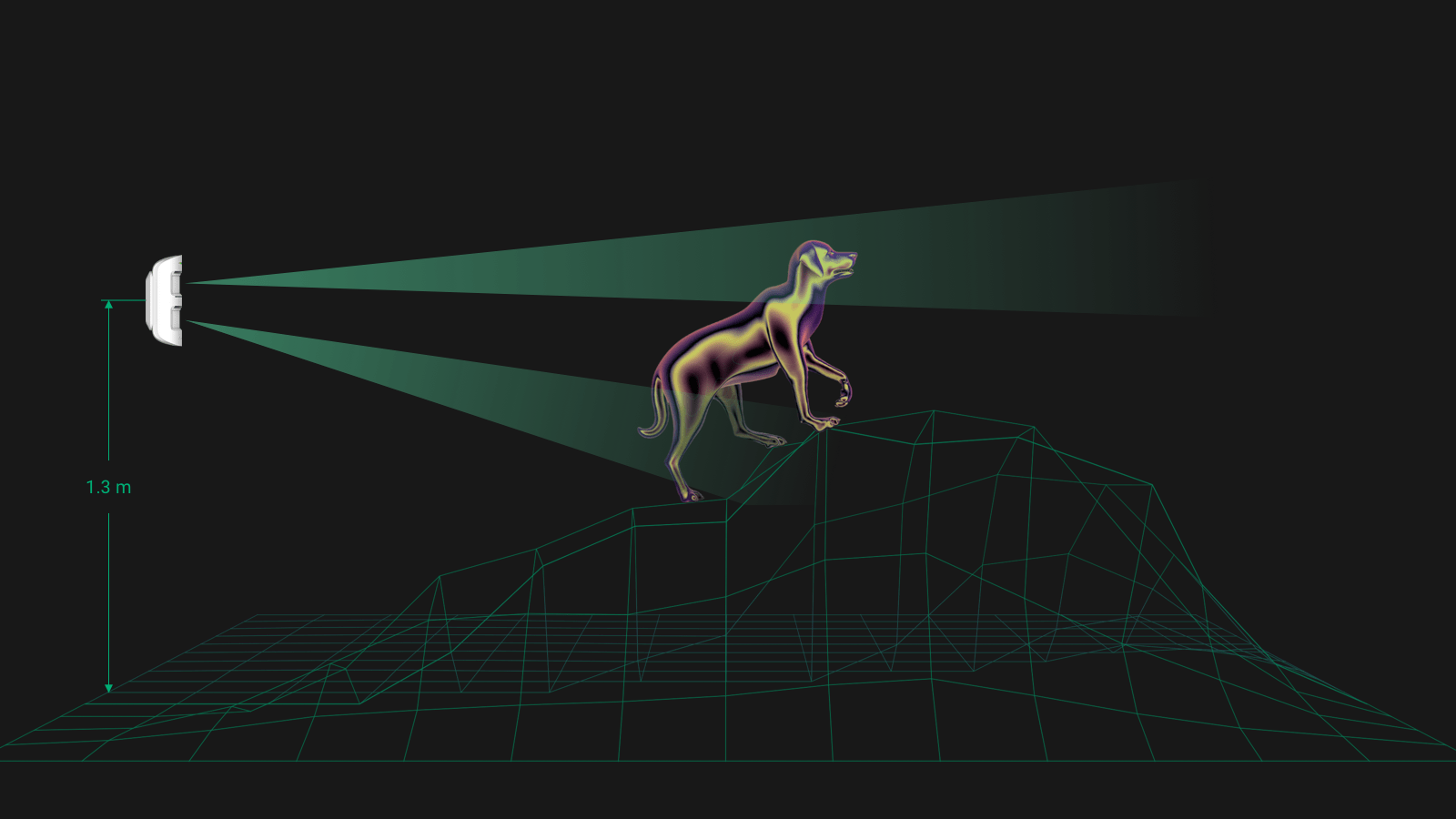
The MotionProtect Outdoor detectors are mounted at a height of 0.8-1.3 metres. The line of sight of the upper lens must be parallel to the ground plane. Even an imperceptible deviation of the line of sight over a long distance will shift the field of view of the upper lens above a person or direct it to the ground. It is therefore important to carry out tests around three detection zones: from the upper lens (correct mounting), the lower lens (human detection range) and then from both lenses.
If the indoor motion detectors are installed below the recommended height, animals are within the hypersensitive zone. If a shepherd dog walks on its hind legs, or even a small spaniel romps on the chair, the detector may trigger an alarm.
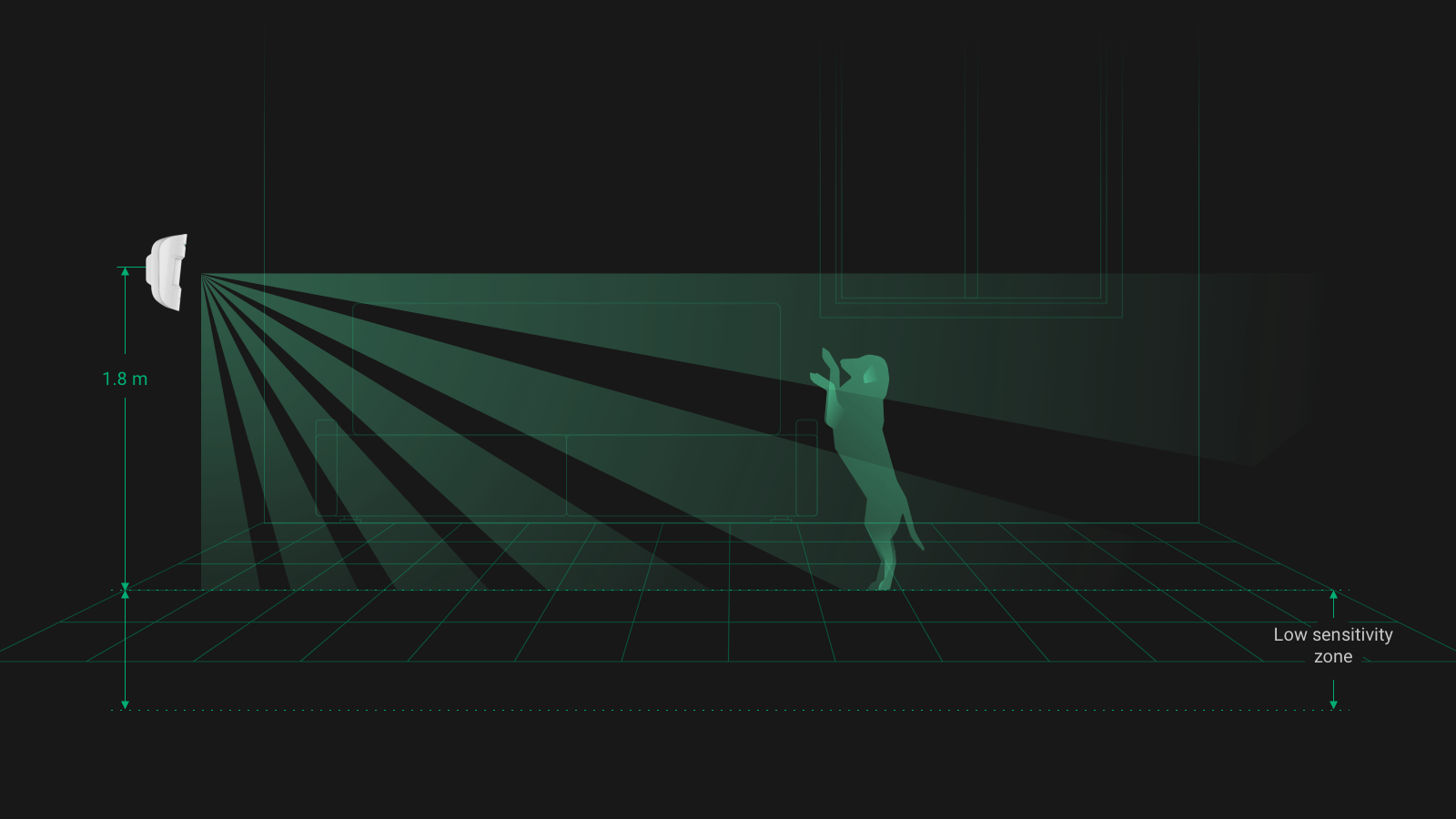
Outdoors, the terrain of the protected area must be taken into account. If a large dog enters the detection area of both MotionProtect Outdoor lenses, the pet immunity function may not be able to cope with it and the detector will trigger an alarm.
2. Set the detector to the correct sensitivity.
When securing rooms with animals in them, the MotionProtect, MotionProtect Plus and CombiProtect detectors are set to medium or low sensitivity, depending on the size of the animal. The sensitivity of the MotionProtect Outdoor detectors is determined empirically: start with medium sensitivity and lower it if a false alarm occurs.
3. Make sure the animal cannot get close to the lens of the indoor detector.
The closer the moving object gets to the lens, the larger the thermal spot becomes. If an agile dog jumps up to detector level near the lens, an alarm is triggered. The same applies to a cat that jumps onto a cupboard to get close to the detector.
Use the new MotionCam motion detectors with visual alarm verification to put your mind at ease and eliminate pointless patrols caused by an animal triggering the alarm. When motion is detected, the detectors take a photo or a series of 2-5 photos. Both you and the security company then know exactly what caused the alarm: a playful pet or a burglar breaking into your home.