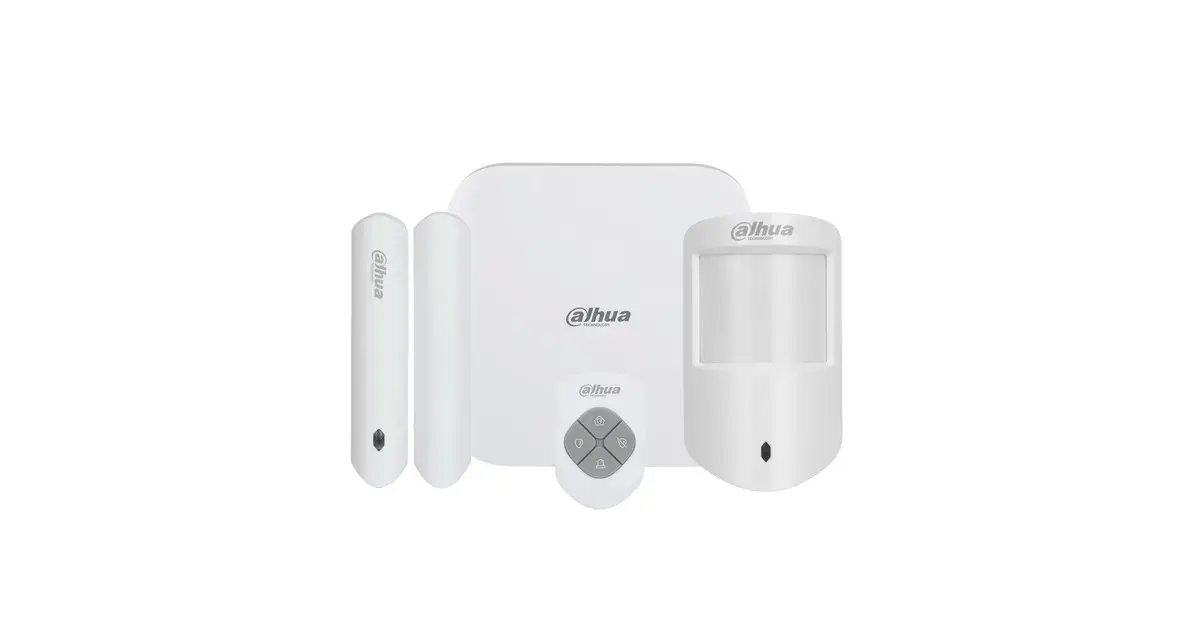
A good wireless alarm protects your property just as reliably as a wired system; the difference lies mainly in installation, expansion, maintenance and features. For most homes and businesses, the wireless Dahua AirShield is quicker to install and more flexible. A traditional wired alarm keeps its place in specific situations. Below you can see them compared fairly side by side.
The main differences
Installation
You mount AirShield wirelessly, with no chasing or breaking into walls. Wired systems require cables to be run.
Expansion
With AirShield, you enrol a detector in the app. With a wired system, it means laying new cables.
Video
AirShield is closely integrated with Dahua cameras. A classic wired alarm is separate from them.
Power supply
Wireless detectors run on batteries; wired ones draw power from the cable, without batteries.
AirShield and wired alarm side by side
| Dahua AirShield (wireless) | Traditional wired alarm | |
|---|---|---|
| Installation | Wireless, no chasing or breaking into walls | Running cables, more building work |
| Install it yourself | Yes, detectors are enrolled via the app | Usually a job for an installer |
| Expansion | Add and enrol a detector, up to 150 devices | New cabling for each device |
| Power supply | Battery (years), hub with backup battery | Fixed power supply via cable, no batteries in detectors |
| Video integration | Deeply integrated with Dahua cameras and video intercoms | Usually separate from camera surveillance |
| Control | DMSS app, no mandatory subscription | Often a keypad or panel; app depends on the system |
| Taking it with you when you move | Easy to remove | Permanently built in |
| Immune to radio interference | Frequency hopping and AES128 against interference and jamming | Cable is inherently immune to radio interference |
Installation without chasing or breaking into walls
The biggest practical difference is installation. With a wired system, you run cables to every detector, siren and the control panel, which involves building work and often an installer. AirShield is wireless: you fix the detectors in place and enrol them via the app, with no cabling through walls and ceilings. That saves time, mess and cost, and also makes the system suitable for an existing or finished home.
Expanding later or taking it with you
If you later want to protect an extra room, with AirShield you simply pair a new detector, up to 150 devices on one hub. With a wired system, expanding means laying cables again. If you move, you can easily take a wireless system with you, whereas wired equipment usually stays behind.
What about the connection?
A common concern is whether wireless is reliable enough. AirShield operates on the 868 MHz band with two-way communication, AES128 encryption and frequency hopping, which greatly limits interference and deliberate blocking (jamming), and the hub immediately notices tampering or an offline detector. A wired system is inherently immune to radio interference and has no batteries in the detectors. Both are therefore reliable; they simply solve the problem differently.
Batteries versus cabling
Wireless detectors last for years on their battery and report in good time when it runs low, so you are never caught out. A wired system has no batteries in the detectors, but the power supply and the panel do require a neat installation. For most users, the convenience of wireless outweighs the occasional battery replacement.
When does a wired alarm still make sense?
A wired system may be preferable for new builds or a major renovation where the cables are being laid anyway, for very large or complex installations, or if you object on principle to batteries in detectors. In most other situations, wireless AirShield offers the same level of protection with less installation work and more flexibility.
Wireless or wired alarm
Is a wireless alarm secure enough?
How often do I need to replace batteries?
Can I install AirShield myself?
Does AirShield work with cameras?
Do I need a subscription?
Wireless security with AirShield
Secures is a Dahua partner and AirShield specialist. We advise you on the right setup, deliver quickly from stock and, if you wish, can have the system installed by our VEB-approved installers.